Data & Methods
FMT runs on public satellite data from established space agencies. This page sets out which sources are used, how a fire detection is reached, and how a regional risk score is calculated.
Method
Detection
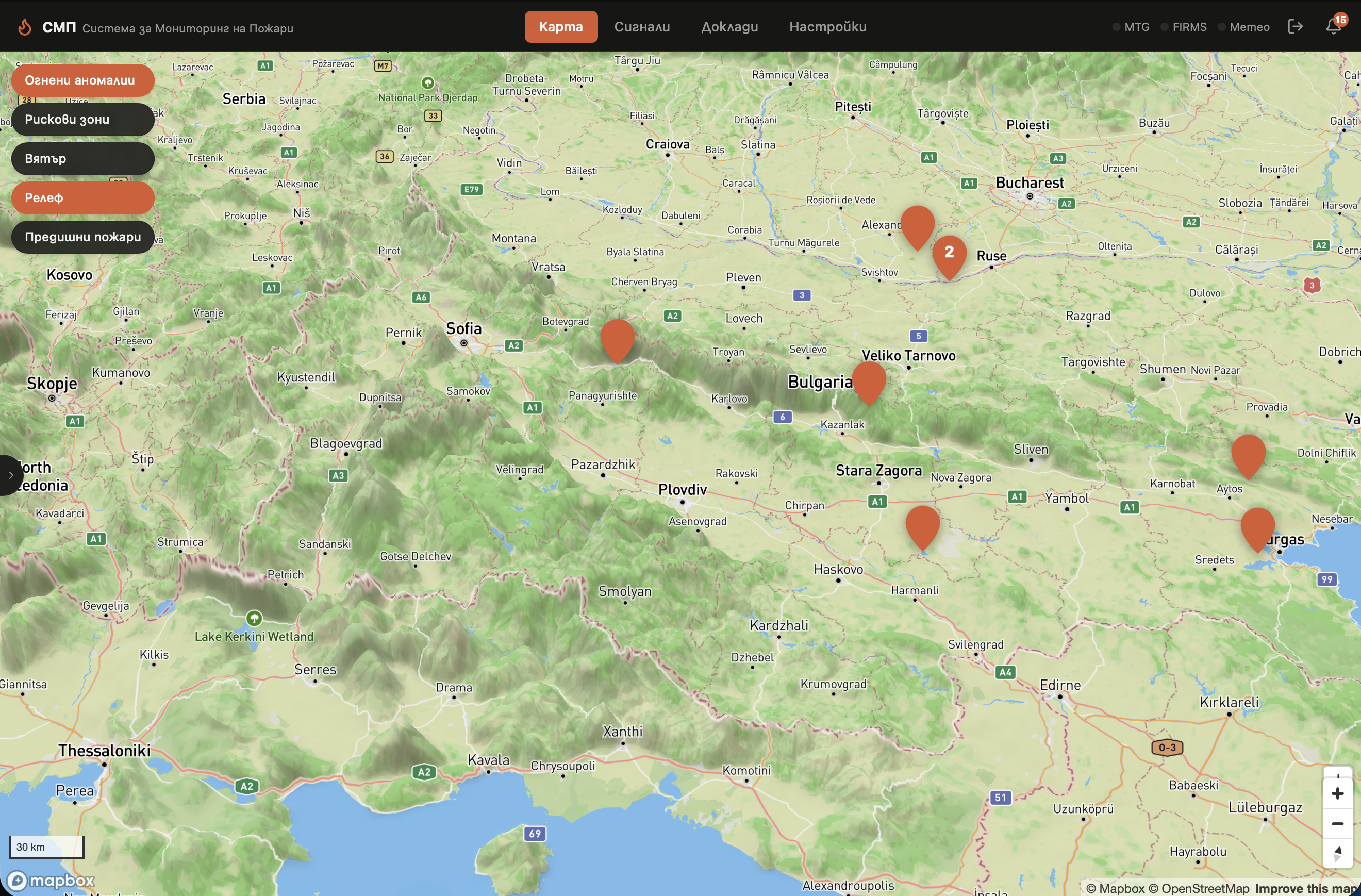
Fire-detecting satellites measure thermal radiation. A pixel is flagged when its measured temperature is high enough to indicate active combustion rather than ordinary ground heating. FMT reads several satellite systems independently: MTG, in geostationary orbit; the polar-orbiting MODIS and VIIRS instruments distributed through NASA FIRMS; and Sentinel-3 SLSTR, which adds Fire Radiative Power from a second polar-orbiting platform. A detection is treated as confirmed when a geostationary trigger and a polar-orbiting pass report fire activity at the same location within a short time window. Single-source detections are recorded but held back from alerting until corroborated.
Risk Scoring
Risk scoring estimates where conditions favour a fire — a separate question from whether one is burning now. Sentinel-2 imagery is converted into NDVI, a vegetation index where lower values indicate dry, stressed vegetation. NDVI values for each region are combined with current conditions and weighted by a scoring model into a numeric risk score. Operators set the minimum score at which a detection generates an alert.
Data Sources
Each source is operated by a public space agency. The links below point to official documentation.
MTG (Meteosat Third Generation)
Operated by EUMETSAT. Geostationary satellites providing frequent thermal observation of Europe, including the full Bulgarian territory.
Official documentationMODIS
Moderate Resolution Imaging Spectroradiometer, operated by NASA. Active fire detections from polar-orbiting satellites, distributed through NASA FIRMS.
Official documentationVIIRS
Visible Infrared Imaging Radiometer Suite. Higher-resolution active fire detections from polar-orbiting satellites, distributed through NASA FIRMS.
Official documentationSentinel-3 (Copernicus)
Optical and thermal mission of the EU Copernicus programme. Its SLSTR instrument provides Fire Radiative Power (SL_2_FRP) active-fire detections, used as an independent polar-orbiting detection stream.
Official documentationSentinel-2 (Copernicus)
Optical imaging mission of the EU Copernicus programme. Multispectral imagery used to derive NDVI vegetation stress for regional risk scoring.
Official documentationNASA FIRMS
Fire Information for Resource Management System. The distribution service through which FMT receives MODIS and VIIRS active fire detections.
Official documentationNo Proprietary Black-Box Models
The risk score is not the output of an opaque model. Its inputs — satellite confidence values, NDVI indices, and cross-source validation — are documented, and the weighting that combines them can be reviewed. An agency relying on FMT can see why a region carries the risk level it does, and trace any alert back to the satellite detections behind it.