How FMT Works
FMT carries a satellite observation through to an operational alert in five stages. Detection and risk scoring run as separate processes — one answers where a fire is burning now, the other answers where conditions make a fire likely.
The Pipeline
Capabilities
Detection
Active fire detections arrive from three satellite systems. MTG provides frequent geostationary thermal imaging across the full Bulgarian territory; NASA FIRMS (MODIS and VIIRS) and Sentinel-3 (SLSTR Fire Radiative Power) contribute polar-orbiting detection streams. FMT ingests all three continuously and treats each as an independent source.
Risk Scoring
Sentinel-2 imagery is processed into NDVI vegetation stress values for each monitored region. An AI scoring model weights NDVI against current conditions to produce a regional risk level. The scoring logic is documented — there are no proprietary black-box models in the risk output. Each detection is assigned a numeric risk score. Operators configure the minimum threshold for alert triggering. The scoring inputs — satellite confidence values, NDVI indices, and cross-source validation — are documented.
Alert Routing
A detection is confirmed when independent satellite sources corroborate it — a geostationary MTG trigger is held back until a polar-orbiting pass from NASA FIRMS or Sentinel-3 confirms fire at the same location. Confirmed detections are matched against the monitored areas configured for each organisation. When a detection falls inside a monitored area, FMT sends an email alert to the recipients configured for that area — before ground observers have visual contact.
Operational Dashboard
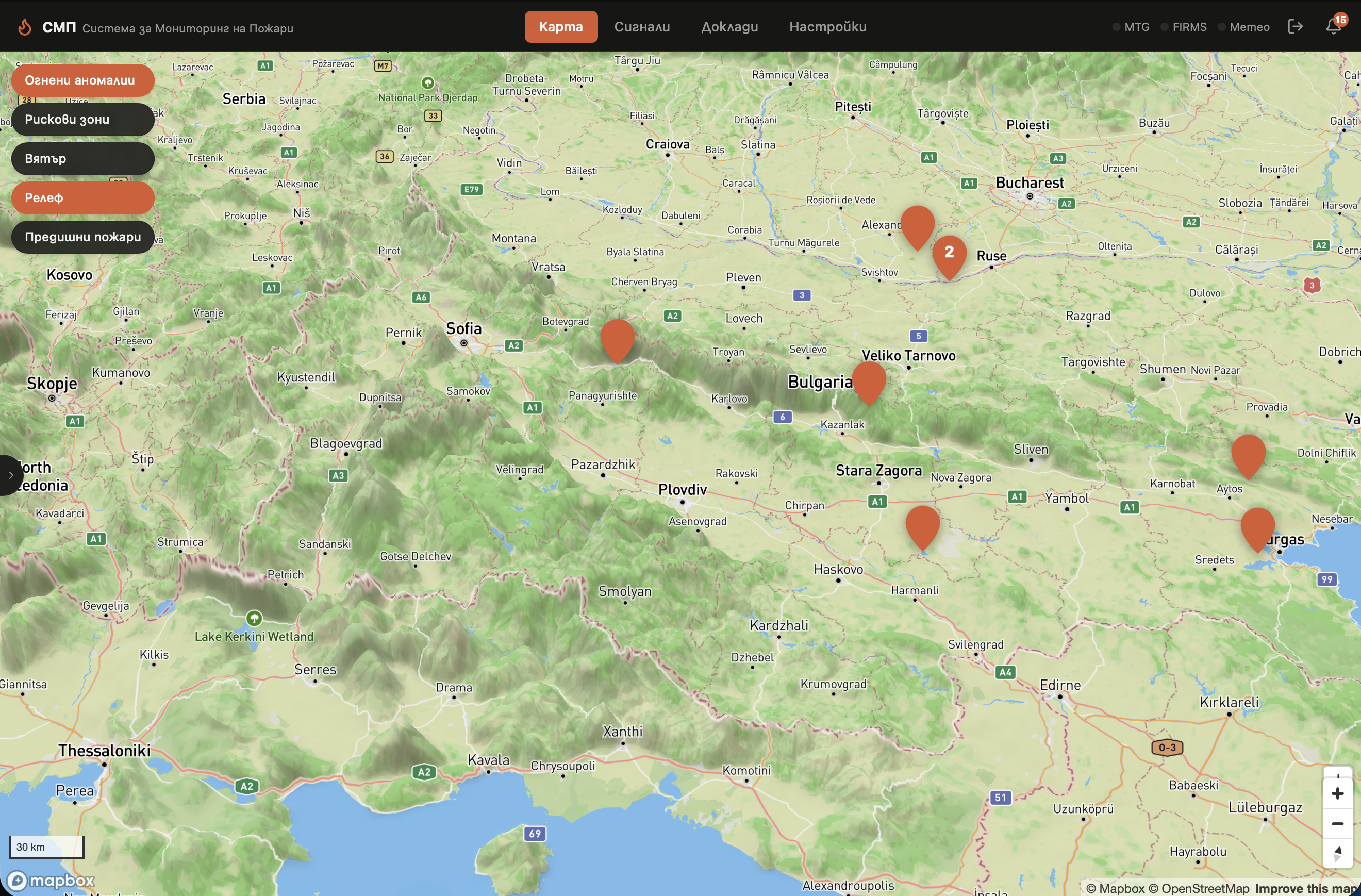
Map
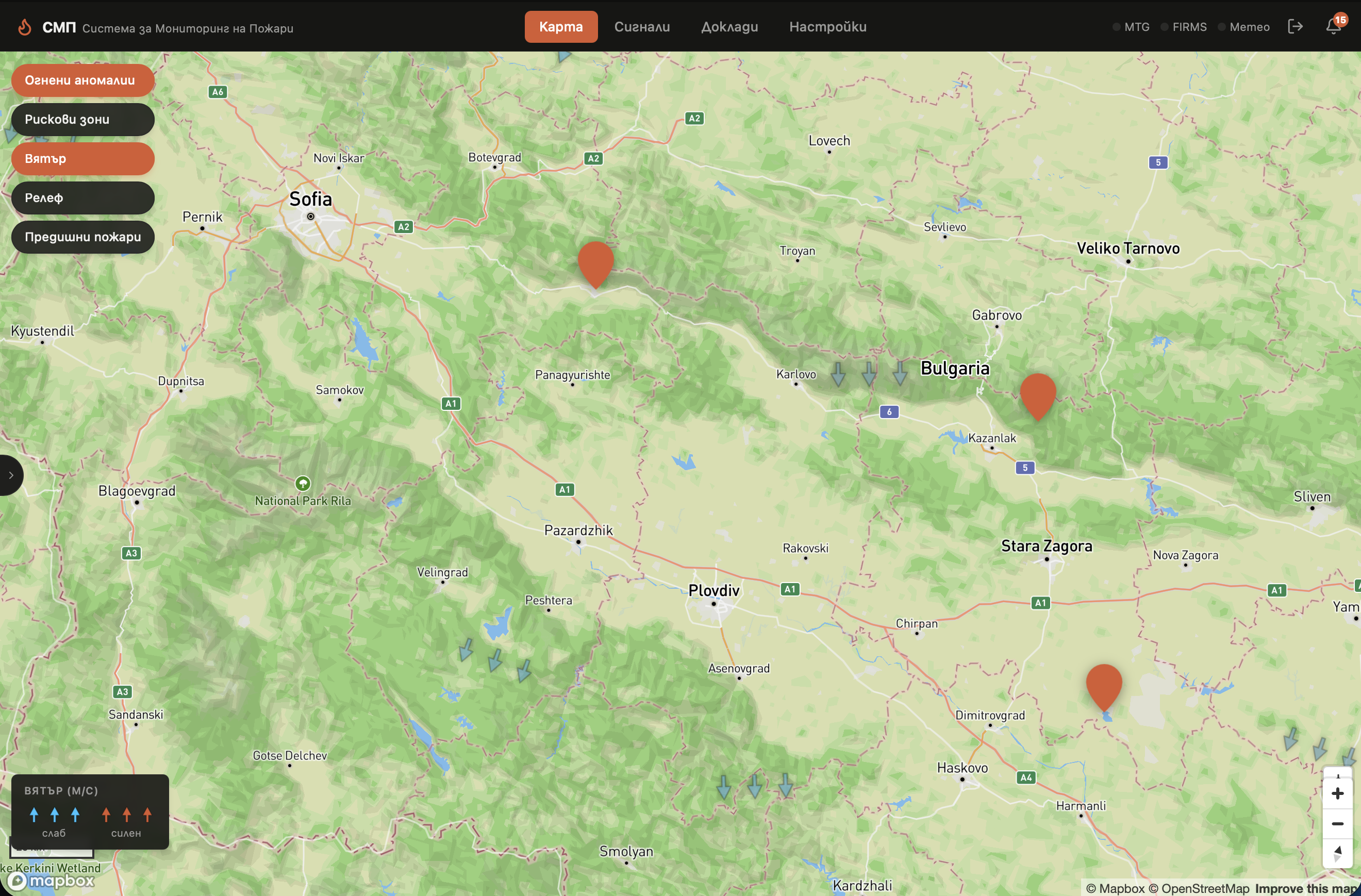
The primary operational view. An interactive map of Bulgaria with five toggleable data layers: active fire anomalies from satellite sources, risk zone overlays, wind speed and direction, terrain relief, and historical fire locations. Live data source status — MTG, FIRMS, and meteorological feeds — is displayed in the interface. Operators see the full picture without switching tools.
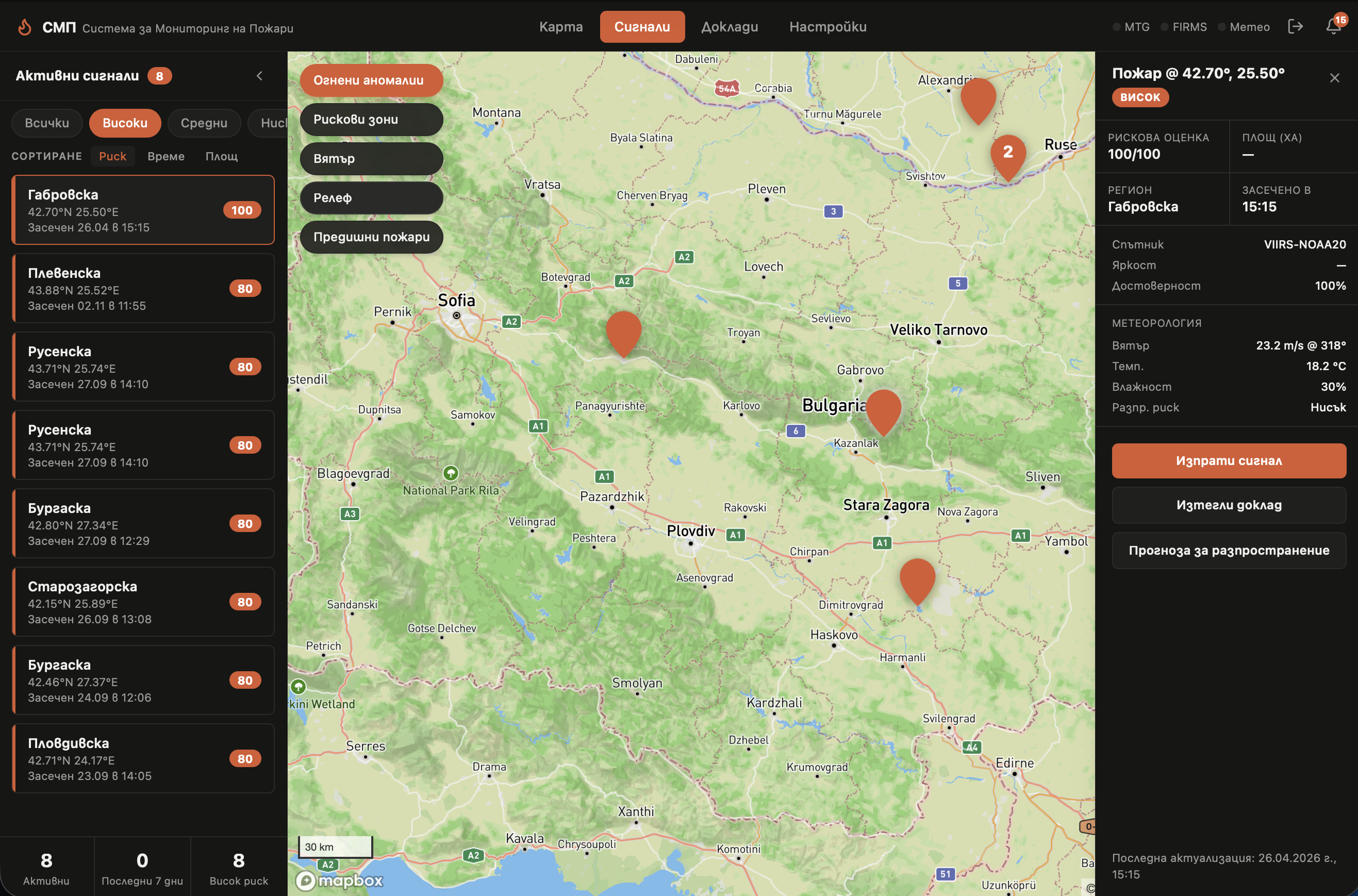
Signals
Every detected fire anomaly generates a signal. Signals are filtered by severity — high, medium, or low — and sortable by risk score, detection time, or affected area. The panel shows total active signals, signals from the last seven days, and the count of high-risk events.
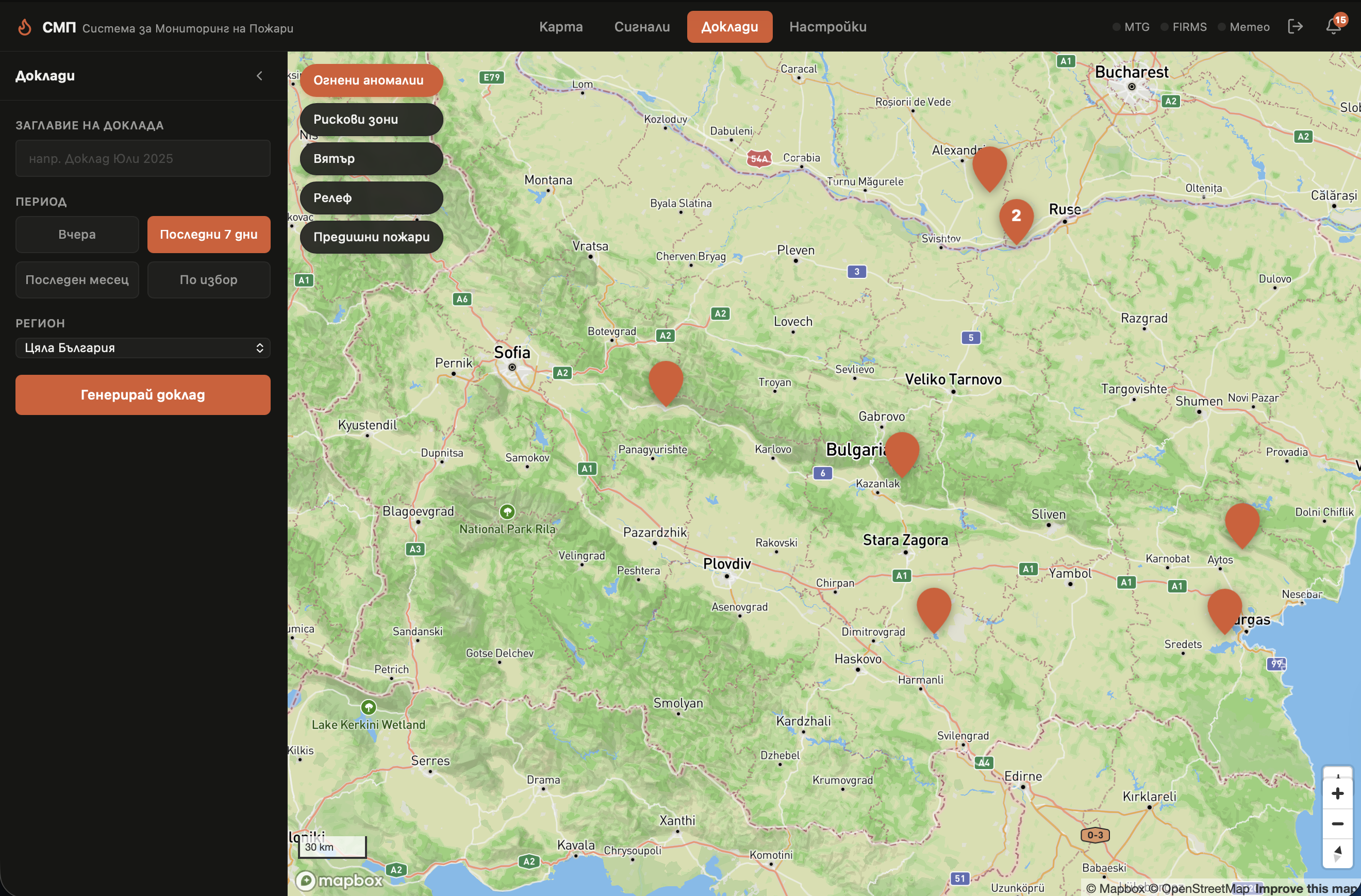
Reports
Generate structured incident reports for any time period — yesterday, the last seven days, the last month, or a custom range — across all of Bulgaria or a specific region. Reports are named and generated on demand, suitable for operational logs, incident documentation, and briefings to regional or national authorities.
Settings
Each installation is configured per agency. Operators set a minimum risk score threshold — detections below that score are logged but do not generate notifications. Satellite source filters allow monitoring from MODIS or VIIRS independently or in combination. Alert delivery is configured per user: email and SMS, with real-time notifications toggled on or off. Monitored regions are selected individually from all 28 Bulgarian administrative regions.
Capability Brief
A written summary of FMT's data sources, detection method, and alerting model is available as a PDF.
Download the FMT Capability Brief (PDF)